
Syria's Chemical Weapons are a true "game changer" for international terrorism
The last few weeks have been
generous in events and catastrophes, from the Boston bombings to the Iraqi
bloodshed, from the attack in Libya against the French embassy to the Somali
terror wave and the Iranian devastating earthquake, yet the landmark that has
been highly overlooked and is of critical importance is the suspected use of
chemical weapons in Syria.
 The French, British and
Israeli intelligence community were affirmative in proclaiming that Assad’s
regime indeed had recourse to chemical weapons against the rebels, and the
allegations were soon to be followed by several pictures of Syrian casualties
presenting symptoms of chemical poisoning which the White House deemed possible
yet not supported by clear and irrevocable evidences.
The French, British and
Israeli intelligence community were affirmative in proclaiming that Assad’s
regime indeed had recourse to chemical weapons against the rebels, and the
allegations were soon to be followed by several pictures of Syrian casualties
presenting symptoms of chemical poisoning which the White House deemed possible
yet not supported by clear and irrevocable evidences.
Deemed a “red line” not to
be crossed and a “game changer” by Obama, the systematic use of chemical
weapons by the Syrian regime seems to be a victorious challenge to the current
administration who cannot but push away the red line further, hoping that Assad
would deign cross it and save the US another humiliating and embarrassing
stance.
Yet…
As much as it seem that a
potential intervention is unlikely giving the cautious rhetoric of Washington,
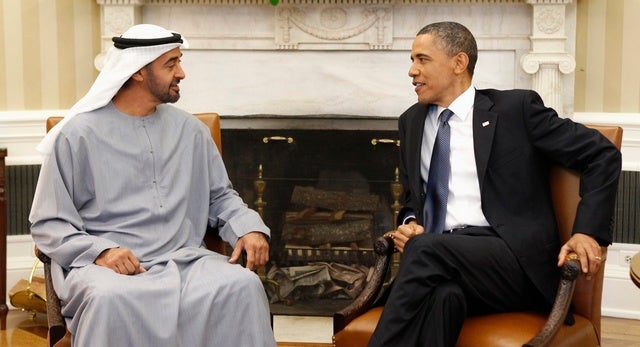
the events on the ground suggest a wholly different approach. The US has
witnessed the last week a convening of various Arab leaders who, by coincidence
or design, have been scheduled in the oval office for private talks with the
president at around the same time period. From the Emirati crown prince of Abu
Dhabi to the leaders of Qatar and Jordan, the choice Obama made is highly
strategic since these countries are the main regional players in the Syrian
conflict, described by Fox News as “believed to be arming or training the rebel
forces that are seeking to overthrow the Syrian government”[1]
in a recent article tackling the meetings Obama held with the aforementioned
leaders.
The timing of the meetings
and the announcement of the usage of Chemical weapons by the Syrian government
suggest a covert preparation for an imminent action in Syria. If the evidence
about a determinate US plan to intervene military against Assad are blurry, the
arguments for such action are not lacking with regards to US interests and
national security imperatives.
The chemical weapons
stockpiled in Syria are significant in numbers, to the extent that it is
believed and assessed by various intelligence communities that “The Syrians
have one of the largest chemical weapons arsenals in the world.”[2]
Chemical weapons are the main source of alarm for the international community
when it comes to the Syrian conflict, first because of the prevalent presence
of Al Qaeda affiliates in the battle ground and their noted superiority in
combat and organization, and second because of the ease of use and deployment
of chemical weapons in terrorist incidents as in the 1995 subway Tokyo attacks.[3]
The Al Nusra rebel front,
one of the most powerful factions battling Assad’s regime and by far its most
radical, didn’t hide its allegiance to Al Qaeda as not only a small part of the
network, but as significant enough to rush the Al Qaeda in Iraq into a merger
with the Islamist jihadist cell. The merger was announced by Abu Bakr
Al-Baghdadi, head of the Islamic state in Iraq, who proclaimed: "We
announce the abolition of the Islamic state of Iraq's name and Jabhat
Al-Nusra's name and their amalgamation in one state under one name: The Islamic
state in Iraq and the Levant."[4]
The news stirred a wide
controversy regarding the armament of Syrian rebels, an armament pursued with
eagerness by Qatar and Co who cannot wait to see Assad regime falling apart.
Yet the issue of channeling the weapons to the right people is of little
concern compared to the chemical weapons acquisition. The weapons delivered to
the Syrian rebellion are of tactical use and have a low range of destruction,
aimed primarily at inducing small-scale, targeted damage, while the chemical
stockpile of the Syrian government contains primarily Sarin, a nerve gas agent
that can spread over large areas and induce quick death through inhalation.[5]
(The Tokyo subway attack stands witness to the deadly effect of Sarin that
claimed the lives of 13 Japanese in 1995).
The ambitions of Al Nusra
front, and of Al Qaeda de facto, to control and lay hand on chemical nerve
agents is no news, yet how close the group is to attain such goal is alarming,
and indeed helps explain the sense of urgency the intervention in Syria is
prompting in the corridors of the White House.
In a recent article in the
Telegraph, Colin Freeman writes:
The fight for al-Safira is no ordinary turf war,
however, and the prize can be found behind the perimeter walls of the
heavily-guarded military base on the edge of town. Inside what looks like a
drab industrial estate is one of Syria's main facilities for producing chemical
weapons - and among its products is sarin, the lethal nerve gas that the regime
is now feared to be deploying in its bid to cling to power.[6]
The prospects of the
Chemical weapons falling in the hands of extremist groups are recognized to be
not only a domestic threat, but also a severe security breach for all regional
actors including Israel and the Arab nations. Most probably the chemical
weapons would be directed towards the spots where Al Qaeda is mostly present
and where the odds for success are in the group’s favor. Iraq, with its weekly
ever rising toll of deaths and attacks, would be the first country outside of
Syria where the Sarin nerve agent would be deployed given the ability of the Al
Qaeda operatives to smuggle the stockpiles into the wrecked country. Securing
the chemical weapons is the priority of al Nusra front, and Syria as it stands
now is not a safe haven to safeguard the precious prize. The need to move the
chemical weapons to Iraq, if ever recovered by extremist cells, is apparent
since the deployment of Sarin gas doesn’t need to be in large proportions. The
rationing of the Chemical weapons into mobile portable loads carried by
individuals for targeted locations is the modus operandi Al Qaeda would adopt
given the restricted access it might have to the substance, and from then on
the branching out of the chemical agent would take effect until tracking the
initial containers becomes a futile intelligence efforts. The network of
dormant cells Al Qaeda manages throughout the MENA region and beyond makes from
the acquisition of nerve agent a true “game changer” in international
terrorism.
Although many would
recall the scandal of the “inexistent” Iraqi WMDs to refute the Chemical
weapons excuse to intervene in Syria, the difference today is that we are faced
with a situation where WMDs existence is not debated but held as a fact. The
Syrian Chemical weapon stockpiles and the omnipresence of Al Qaeda affiliates
in the battlefield is not debatable, and the recent battles ranging near
military bases harboring nerve agents production and stockpiling facilities
hint clearly to the possibility that a catastrophe situation might rise at any
moment, a catastrophe where later containment is not an option.
Many have started
calling for a more strategic approach towards supporting the Syrian rebellion,
and it is now more than ever critical to adopt such a strategy if we are to
avoid the unpleasant occurrence of a nerve agent attack in an Iraqi mall or a
Lebanese public square.
 Judging from the
available mappings of Syrian chemical facilities, most installations trail
along the western border with Lebanon and the Mediterranean Sea. This
geographical occurrence is of high strategic importance: The necessity to
control these facilities is easier since most rebel secured areas lay on the
western part of the country, and a potential intervention from regional or
international corps launched from Lebanon and the Mediterranean shores will
allow a quick takeover of the chemical plants to secure and systematically
destroy the nerve agents. The establishments of no-fly zone partly over Syria,
and specifically over the Western border will enable a constant monitoring of
the facilities and an instantaneous response if hostile groups are seen
entering the bases.
Judging from the
available mappings of Syrian chemical facilities, most installations trail
along the western border with Lebanon and the Mediterranean Sea. This
geographical occurrence is of high strategic importance: The necessity to
control these facilities is easier since most rebel secured areas lay on the
western part of the country, and a potential intervention from regional or
international corps launched from Lebanon and the Mediterranean shores will
allow a quick takeover of the chemical plants to secure and systematically
destroy the nerve agents. The establishments of no-fly zone partly over Syria,
and specifically over the Western border will enable a constant monitoring of
the facilities and an instantaneous response if hostile groups are seen
entering the bases.  Moreover, the
differing strength of Al Nusra group and the more liberal rebellious factions
suggests that the commanders in chief of the free Syrian Army should redirect
their efforts and progressions towards the Western border to help secure the
stockpiles of chemical weapons, leaving the battle for Damascus and the most
costly fights for Al Nusra faction in order to undermine the capabilities of
the group and let it bear most casualties and damages in an effort to overtake
it financially and logistically in the post-Assad Syria. The redeployment of the
free Syrian army fully in the Western part of the country, leaving the Deir
Ezor and eastern Aleppo area for the Al Nusra Group will help mildly separate the
two rebellious groups and facilitate the directed armament and logistical provision
to the Free Syrian army instead of blindly empowering both factions.
Moreover, the
differing strength of Al Nusra group and the more liberal rebellious factions
suggests that the commanders in chief of the free Syrian Army should redirect
their efforts and progressions towards the Western border to help secure the
stockpiles of chemical weapons, leaving the battle for Damascus and the most
costly fights for Al Nusra faction in order to undermine the capabilities of
the group and let it bear most casualties and damages in an effort to overtake
it financially and logistically in the post-Assad Syria. The redeployment of the
free Syrian army fully in the Western part of the country, leaving the Deir
Ezor and eastern Aleppo area for the Al Nusra Group will help mildly separate the
two rebellious groups and facilitate the directed armament and logistical provision
to the Free Syrian army instead of blindly empowering both factions.
The Libyan downfall
and the following dispersion of vast amounts of artillery in the region have
had a direct effect on facilitating the Malian crisis emergence and AQMI rearmament.
Today we are faced with an even more devastating type of weaponry in an area
known for its high volatility. The consequences of Chemical weapons falling in
the wrong hands will inevitably set new standards for terrorist activities, and
will have far reaching impacts regionally and internationally. This is a “game
changer” whose significance the US administration and the Arab governments
understand very well, therefore the necessity for intervention has turned from
a debate into a consensual agreement whose first signals were the series of
meetings with Middle Eastern leaders in Washington, and whose ultimate ending
will be a dramatic military action in Syria; the road to the final action is
and remains convincing an ever skeptical public opinion, a conviction that
seems all too well settling down after a tragic set of events that shook the
public consciousness and laid a state of fear we have so many times encountered
before major military implications in foreign countries.
Mohamed Amine Belarbi
[2] https://medium.com/today-in-syria/b9e9411a7429
[3] http://en.wikipedia.org/wiki/Sarin_gas_attack_on_the_Tokyo_subway
[4] http://www.bbc.co.uk/news/world-middle-east-22078022
[5] http://vitals.nbcnews.com/_news/2013/04/25/17917132-how-deadly-nerve-gas-sarin-kills?lite
[6] http://www.telegraph.co.uk/news/worldnews/middleeast/syria/10022753/Syria-Al-Qaedas-battle-for-control-of-Assads-chemical-weapons-plant.html


.jpg)

